


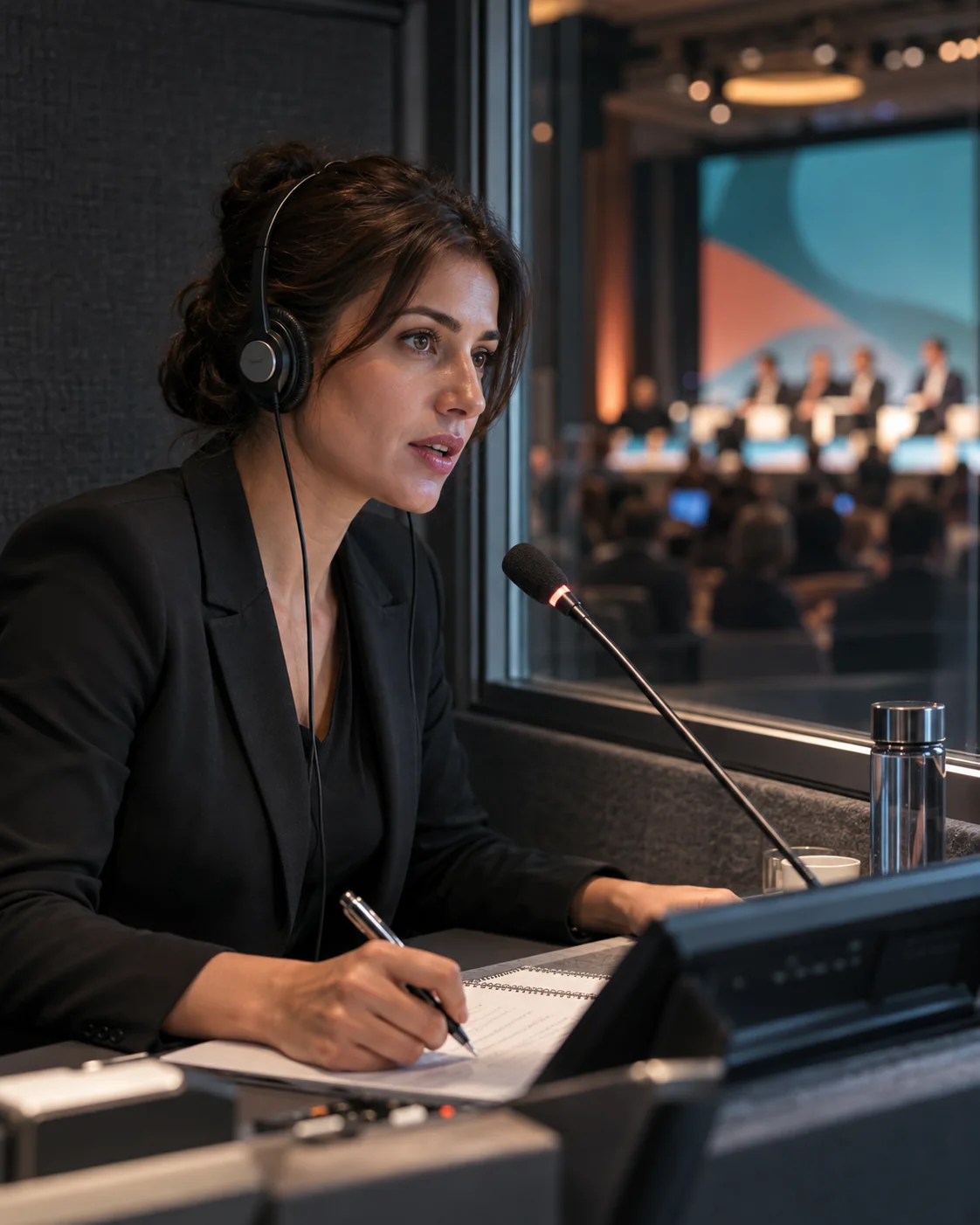
Short answer: For continuous simultaneous interpreting from one source language into one target language in a single room, planning generally starts with a team of two. However, “my event is bilingual, so two interpreters will be enough” is not a reliable rule for every programme. The team must cover the actual language directions at the times they are needed.
This guide is for organisers planning conferences, congresses, corporate meetings or technical training in Ankara and elsewhere in Türkiye. The examples provide a starting point for budget discussions; a confirmed team proposal requires review of the current agenda and language requirements.
Start with Language Directions, Not Just Language Names
Writing only “Turkish–English” in an enquiry can leave the scope unclear. Will speakers present in English with interpretation only into Turkish? Must questions in Turkish also be interpreted into English? Which languages will the moderator, panellists and audience use? A one-way presentation and a two-way panel are different assignments.
- Spoken languages: Which languages will people on stage and in the audience use?
- Listening languages: Into which languages must interpretation be available?
- Timing: Are those directions needed throughout the day or only in specific sessions?
A useful first step is to add the spoken language, required listening languages and room name beside each agenda session. That short schedule is a better basis for a quote than the event title alone.
Team Examples for Common Conference Formats
The figures below depend on stated assumptions. Changes to rooms, language directions or working time require reassessment. Use these examples to describe the programme, rather than as an automatic headcount calculator.
1. One room, presentations interpreted from English into Turkish
Two interpreters are the general starting point for continuous one-way coverage. If Turkish will be spoken during questions and answers, the scope changes; specify the reverse direction.
2. A conference with interpreting in both Turkish and English
AIIC’s team table provides for three interpreters when both languages are interpreted into each other. In some short or general meetings, two may be possible if both can work into both languages. Do not automatically assume a pair is sufficient for a full-day panel programme.
3. English presentations interpreted into Turkish and German
For continuous interpretation from one spoken language into two listening languages, an illustrative starting point is two language teams, four interpreters in total. This differs from a conference where all languages are used in both directions.
4. Two rooms running at the same time
If both rooms need continuous English-to-Turkish interpretation at the same time, the pair in the first example cannot cover both. Under those assumptions, two per room, four in total, is a discussion starting point. Two-way coverage or longer programmes need separate assessment.
How Do Session Length and Breaks Affect Team Size?
Rather than sending only “09:00–17:00”, show when talks start and finish, genuine breaks, lunch and additional sessions. A panel after the presentations, an evening meeting or a workshop may also need interpreting. Adding them after quotation can change the team's agreed working arrangements.
Changing the active microphone within a booth does not replace a scheduled break. For overrunning sessions, agreeing duration and additional scope in advance provides a clearer plan than assuming the team can simply continue. For dense technical presentations, also indicate when the preparation material will be available.
Does Audience Size or the Number of Parallel Rooms Matter More?
Audience size matters, but does not determine interpreter numbers by itself. Fifty or five hundred people listening to the same speech through one language channel do not automatically require different interpreting teams. Two small rooms hosting different discussions at the same time may each need separate language coverage.
Still include attendance in the brief: it affects receivers, headsets, distribution and technical arrangements. Ask for interpreters, booths and language channels, and listener equipment to appear as separate items within the same budget.
How Are Teams Planned for Multilingual and Relay Conferences?
For three or more languages, “number of languages × two” is not an exact rule. A language matrix should show which output channels must cover each spoken language. With relay, one booth's output becomes another booth's input; make that dependency explicit in the team plan.
For organisers, the useful question is not only “how many people?” Ask whether the proposed team can cover every listed spoken language in every required listening channel. Individual language combinations and session allocation need to be reviewed together.
Does a Remote or Hybrid Event Need Fewer Interpreters?
Moving from a venue to an online platform does not remove simultaneous language requirements. If two online sessions run different discussions at the same time, assigning the same interpreter to both is not a solution. Remote delivery also adds rehearsal, technical support, platform channels and handover arrangements to the brief.
For hybrid programmes with on-site and remote speakers, establish how each audio source reaches the interpreters. Plan this alongside staffing instead of leaving it as an unrelated technical detail until the end.
What Should You Compare Between Two Quotations?
Two prices for the same event title may cover different services. One may include only the plenary, while another includes panels and workshops. Before comparing per-person fees, check the following scope side by side.
- Interpreter numbers, working days and assigned rooms
- Source and target languages, including reverse directions during Q&A
- Agreed session times, breaks and arrangements for extensions
- Booths, consoles, receivers, headsets, platform and technical operator
- Preparation and rehearsal; travel, accommodation and use of recordings where relevant
A better budget does not always mean a smaller team. Removing an unnecessary language channel, avoiding session clashes or grouping a topic in one room can simplify the scope. Assess these changes against the programme and participants' actual needs.
What Should You Send Us for a Team and Price Proposal?
You can share a draft agenda before every detail is final. Mark any open decisions so the quotation's assumptions remain clear. For a conference in Ankara or a corporate event elsewhere in Türkiye, send:
- Date and location: City, venue or online platform; number of days and time zone.
- Agenda: Speaking times, breaks, panels, workshops and parallel rooms.
- Language directions: Who will speak which language, and who needs which listening language?
- Subject and documents: Sector, technical detail, slides and terminology file.
- Technical scope: Existing booths and audio, receiver quantities, rehearsal and recording plans.
- Decision timeline: Quotation deadline, outstanding approvals and sessions that may change.
Frequently Asked Questions About Interpreter Numbers
Is one interpreter enough for a one-hour meeting?
Duration alone is not enough to decide. Content, language directions, preparation and working conditions must be assessed before assuming a solo arrangement. Share the timing and programme so the delivery model can be reviewed.
Does a small number of foreign participants reduce the team?
A small audience does not shorten the task if the same programme still needs interpreting throughout. The participants' seating and actual language needs can be reviewed as part of the delivery plan.
Is the number of interpreters the same as the number of booths?
No. Several interpreters can share a booth and take turns. Booth numbers relate to output languages and the technical arrangement; staffing also depends on language coverage and workload.
Can an existing team cover a session added later?
Sometimes, but clashes, overall duration, subject and language directions must be checked. Update the agenda and reconfirm team availability whenever a session is added.